
Emergency Fund in 2026: How Much You Need, Where to Keep It (HYSA vs CDs vs T-Bills), and a Step-by-Step Plan
SEO Meta Title: Emergency Fund 2026 Guide: Best Places to Save & How Much
Meta Description: Learn how much emergency fund you need in 2026. Compare HYSA vs. CDs vs. T-Bills, and follow our 30-day plan to secure your financial future today.
URL Slug: emergency-fund-guide-2026
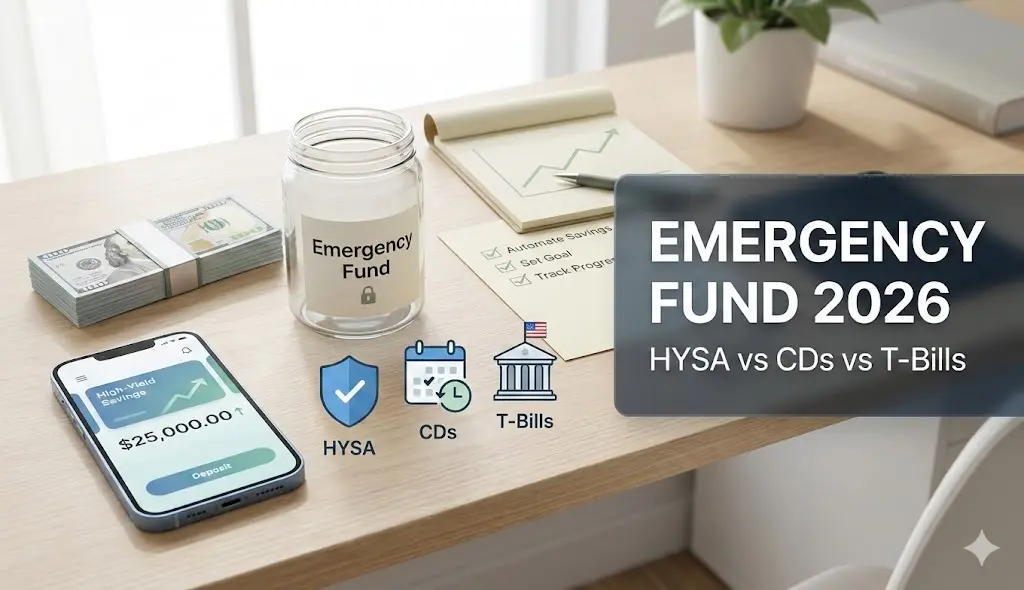
Featured Snippet Answer: An emergency fund is a liquid cash reserve kept in accounts like a High-Yield Savings Account (HYSA) or T-Bills to cover unexpected life events. In 2026, experts recommend saving 3 to 6 months of core living expenses to ensure financial resilience against inflation and job market shifts.
introduction
- Target: Aim for an emergency fund 3 to 6 months of essential expenses.
- Best Tools: Use a high yield savings account for liquidity and Treasury bills (T-bills) for tax advantages.
- Security: Always verify the FDIC insurance limit 250,000 at your bank.
- Strategy: Start with a $1,000 milestone and automate your growth.
Disclaimer: This article is for educational purposes only and does not constitute financial, legal, or tax advice.
What Is an Emergency Fund (and What It’s Not)
An emergency fund is your financial “break glass in case of emergency” box. It is a dedicated stash of cash specifically for life’s curveballs—job loss, medical emergencies, or urgent home repairs. It is not an investment for wealth building, nor is it a fund for planned expenses like vacations.
The core goal here is liquidity vs return. You need to know that if the world turns upside down tomorrow, you can access your cash immediately without selling stocks at a loss. According to the latest emergency fund guide from the CFPB, having this cushion is the single most effective way to stay out of high-interest debt when trouble strikes.
How Much Emergency Fund Do You Need in 2026?
The question of how much emergency fund do I need has evolved. In 2026, with shifting economic landscapes, a “one size fits all” approach no longer works. You need to calculate your “Core Expenses”—the bare minimum needed to survive.
The Realistic Breakdown:
- The Starter Fund ($1,000 – $2,000): This is for people currently paying off high-interest debt. It stops you from adding to your balance when a tire blows out.
- Emergency fund 3 to 6 months: This remains the gold standard for most W-2 employees with stable jobs and moderate expenses.
- The 9–12+ Month Cushion: Highly recommended for freelancers, business owners, or single-income households. Data from the Federal Reserve on household well-being shows that those with larger reserves experience significantly less financial stress during market volatility.
Where to Keep an Emergency Fund: HYSA vs CDs vs T-Bills
Choosing the best place to keep emergency fund assets is about maximizing safety and yield.
High-Yield Savings Account (HYSA)
The most popular choice for 2026. A high yield savings account offers the best balance of accessibility and interest. Your money stays liquid, and most importantly, it is protected by the FDIC insurance limit 250,000 per institution.
Certificates of Deposit (CDs)
When comparing HYSA vs CD, remember that CDs lock your money for a set term. While you might get a higher rate, SEC Investor.gov warns of early withdrawal penalties that can eat into your savings. Use a CD ladder strategy to keep portions of your cash maturing at different times.
Treasury Bills (T-bills)
Treasury bills (T-bills) are a 2026 favorite for high-income earners. They are short-term government securities with terms ranging from 4 to 52 weeks. A massive advantage is that interest earned is exempt from state and local taxes, as detailed in IRS Topic No. 403.
Comparison Table: 2026 Savings Options
| Feature | HYSA | CDs | T-Bills |
|---|---|---|---|
| Liquidity | High (Instant) | Low (Locked) | Medium (Marketable) |
| Tax Advantage | None | None | State & Local Tax Exempt |
| Safety | FDIC Insured | FDIC Insured | U.S. Gov Backed |
| Strategy | Direct Deposit | CD Ladder | T-Bill Ladder |
Step-by-Step: Build Your Emergency Fund
Following a structured emergency fund plan step by step removes the overwhelm of saving large sums.
- Pick your first milestone: Aim for $500. It’s small enough to be achievable but large enough to handle minor mishaps.
- Automate deposits: Treat your savings like a bill. Even $50 per paycheck adds up.
- Find instant wins: Audit your monthly subscriptions. That $15 streaming service you don’t watch is $180 a year for your fund.
- Build a ladder: Once you hit your 3-month goal, start a 4-week 13-week 26-week T-bill ladder with any excess to optimize your returns.
30-Day Emergency Fund Plan
- Week 1: Track all expenses and identify “leaks.”
- Week 2: Open a high-yield account at a separate bank.
- Week 3: Sell unused household items (the “declutter for cash” method).
- Week 4: Set up your first automated transfer.
90-Day Emergency Fund Plan
- Days 31–60: Focus on increasing your income through side hustles or overtime.
- Days 61–90: Review your progress and adjust your “Core Expenses” calculation based on real-world spending.
Emergency Fund vs Sinking Funds
Don’t confuse your emergency cash with sinking funds. Sinking funds are for known future costs (holidays, new tires, annual insurance). Your emergency fund is for the unknown. Using your emergency cash for a planned vacation is one of the most common mistakes that keep people financially stuck.
Common Mistakes That Keep People Stuck
- Keeping the fund in a regular checking account (too easy to spend).
- Waiting until the “end of the month” to save.
- Investing emergency cash in the stock market.
- Not refilling the fund immediately after an emergency.
- Ignoring the state tax benefits of government-backed securities.
- Stopping at $1,000 when your life requires more.
- Mixing emergency fund vs sinking fund categories.
- Not checking if your bank is properly FDIC insured.
FAQ (Answer These Clearly)
What is the best place to keep an emergency fund?
For most, a High-Yield Savings Account (HYSA) is best due to its immediate liquidity and FDIC protection.
Is $1,000 enough for an emergency fund in 2026?
It’s a great start, but Federal Reserve data suggests that many common emergencies now exceed this amount. Aim for 3 months of expenses as soon as possible.
How do T-bill ladders work?
You buy bills that mature at different intervals (e.g., every 4 weeks), ensuring that a portion of your money becomes available cash regularly while the rest earns interest.
Is interest from an HYSA taxable?
Yes, it is subject to federal and state income tax. This is why many investors prefer T-bills in high-tax states.
External Resources & References
- Consumer Financial Protection Bureau: Essential Guide to Emergency Funds
- Federal Reserve: Economic Well-Being of U.S. Households Report
- Federal Reserve Data: Unexpected Expenses Table
- FDIC: Understanding Deposit Insurance Coverage
- TreasuryDirect: Treasury Bills Basics and Terms
- IRS: Tax Topic 403 – Interest on U.S. Obligations
- SEC Investor.gov: Guide to Certificates of Deposit (CDs)