
Credit Card Debt Payoff in 2026 Avalanche vs Snowball and 0 Percent Balance Transfers
Introduction
- Automate First: Never miss a minimum payment to protect your credit score.
- Choose a Strategy: Use Snowball for quick wins or Avalanche to minimize interest.
- Stop the Bleeding: Pause new spending on high-interest cards immediately.
- 0% Transfers: Useful tools but watch for 3–5% upfront fees and strict deadlines.
- Negotiate: Call your issuer to request a lower APR; it’s free and often successful.
- Systems Matter: Use trackers and “sinking funds” to prevent future debt cycles.
Disclaimer: This article is for educational purposes only and does not constitute financial advice.
Getting out of debt can feel like trying to run a marathon in sand. In 2026, many Americans are feeling the weight of high-interest rates, but a clear credit card debt payoff plan can change the trajectory of your year. By combining behavioral psychology with smart math, you can stop feeling stuck and start seeing progress.
Why Credit Card Debt Is So Expensive in 2026
If you feel like your balances aren’t budging despite monthly payments, you aren’t imagining things. As of late 2025, commercial bank interest rates on credit card plans have hovered near 22–23%. When your APR is this high, a significant portion of every payment goes toward interest rather than reducing the principal.
The “minimum payment trap” is designed by issuers to keep you in debt for decades. By paying only the minimum, you are barely covering the interest and a tiny sliver of the balance. According to the New York Fed Household Debt Report, total household debt reached record highs in 2025, with credit card balances exceeding $1.3 trillion. To break free, you must pay more than the minimum and target specific debts strategically.
Debt Snowball vs Debt Avalanche: Which Works Better?
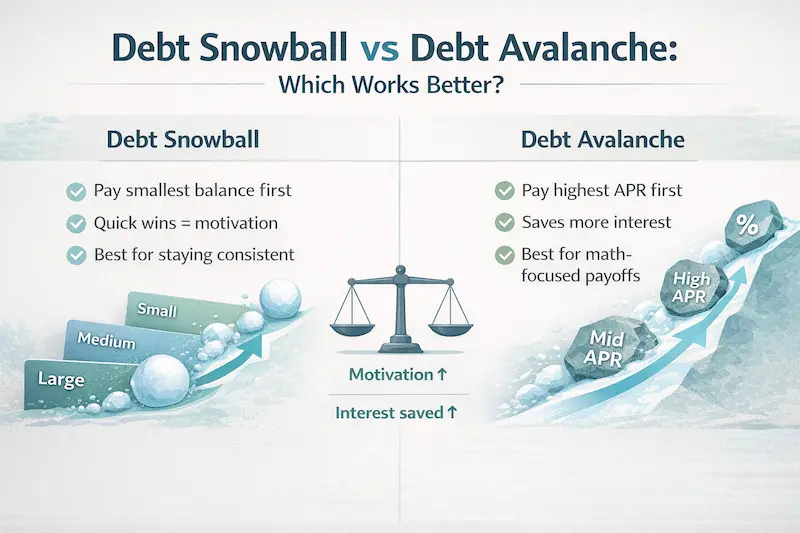
Choosing a credit card debt payoff method depends on whether you value mathematical efficiency or psychological momentum. Both methods require you to pay the minimum on all cards except one, which receives every extra dollar you can find.
Quick definitions (Snowball vs Avalanche)
- Debt Snowball Method: You list debts from smallest balance to largest. You ignore interest rates and focus on closing accounts quickly to gain “quick wins.”
- Debt Avalanche Method: You list debts from highest interest rate to lowest. You target the card costing you the most in interest first, regardless of the balance.
Example: 3-card payoff comparison
Imagine you have $500/month available for debt repayment across these three cards:
- Card A: $1,000 balance (18% APR)
- Card B: $5,000 balance (29% APR)
- Card C: $500 balance (22% APR)
| Strategy | Primary Target | Why? | Result |
|---|---|---|---|
| Snowball | Card C ($500) | It’s the smallest balance. | You close an account in ~1 month, boosting motivation. |
| Avalanche | Card B ($5,000) | It has the 29% APR. | You pay the least interest overall. |
The best method is the one you’ll finish
While the debt avalanche method is technically “cheaper” because it saves on interest, the debt snowball method is often more effective for those who struggle with burnout. Seeing a balance hit $0 provides a hit of dopamine that keeps you going. If you are highly disciplined, use the avalanche; if you need encouragement, stick with the snowball. [Internal link: Budgeting Methods]
Step Zero: Stop the Bleeding (Before You “Optimize” Anything)
You cannot fill a bucket that has a hole in the bottom. Before you start a debt payoff plan, you must secure your current situation.
Automate minimum payments to avoid late fees
A single late payment can trigger penalty APRs and tank your credit score. Set up autopay for the minimum amount on every single card. This ensures you stay “current” while you manually direct extra funds to your target card.
Create a “no new debt” guardrail
Stop using the cards you are trying to pay off. If you continue charging new purchases, you may lose your grace period. When you carry a balance, new purchases often accrue interest immediately. Consider using a “cash stuffing budget” or a separate debit card for daily needs. [Internal link: No-Spend Challenge]
Build a tiny emergency buffer
Most people fall back into debt because an unexpected expense forces them to use a credit card. Aim for a “starter” emergency fund of $1,000 to $2,000. This acts as a barrier between you and new high-interest debt.
0% Balance Transfers in 2026: When They Help
A 0% balance transfer can be a powerful tool to pay off credit card debt by pausing interest for 12 to 21 months. However, it is not “free money.”
Balance transfer fees explained
Most cards charge a balance transfer fee, typically 3% to 5% of the amount moved. If you transfer $5,000 with a 5% fee, $250 is added to your balance immediately. You must ensure the interest you’ll save is significantly higher than this fee.
The grace period trap
If you use your 0% transfer card for new purchases, you might be charged interest from day one. To understand the fine print, review the CFPB’s credit card key terms carefully.
How to Stop Paying 20%+ APR Without a Balance Transfer
If you don’t qualify for a new card, you can still lower your credit card APR through negotiation.
Ask for a lower APR (Script)
Call your issuer’s customer service and say: “I’ve been a loyal customer for [X] years and I’m looking at other options with lower rates. Can you lower the APR on this account?” If they say no, ask for a temporary “hardship program.”
Consider credit counseling vs scams
Legitimate non-profit credit counseling agencies can help, but beware of credit card interest rate scams. Avoid any company that promises to “erase” your debt or charges massive upfront fees.
The 60-Minute Setup Checklist
- Gather Statements: List every card, balance, and APR.
- Set Autopay: Link your bank to pay at least the minimum on all cards.
- Pick Your Target: Label one card as “The Target.”
- Audit Your Spending: Find $50–$100 in monthly subscriptions to cancel.
- Freeze the Cards: Physically move cards to a drawer.
30-Day Credit Card Debt Payoff Plan
- Week 1: Complete the 60-minute setup.
- Week 2: Create a bare-bones budget.
- Week 3: Sell one item to make a “bonus” payment.
- Week 4: Review progress and celebrate the win.
90-Day Credit Card Debt Payoff Plan
- Month 2: Start a “sinking fund” for irregular expenses.
- Month 3: If a card is paid off, move that card’s entire previous payment to the next card.
Common Mistakes That Keep People in Credit Card Debt
- Closing paid-off accounts.
- Forgetting about the balance transfer fee.
- Using the 0% card for new shopping.
- Not having an emergency fund.
- Paying only the minimums.
- Falling for “debt settlement” scams.
- Ignoring the “grace period” rules.
- Using “buy now, pay later” simultaneously.
- Not tracking daily spending.
- Waiting for a “perfect time” to start.
FAQ
Is the debt snowball or avalanche better for 2026?
The avalanche saves more money, but the snowball is often better for mental health.
What is a typical balance transfer fee?
Expect to pay between 3% and 5% of the total amount transferred.
How does 20% APR impact my balance?
On a $5,000 balance, 20% APR adds nearly $83 in interest charges every month.
Can I negotiate my credit card interest rate?
Yes. Many issuers will lower your rate if you have a history of on-time payments.
Will a 0% transfer hurt my credit score?
Opening a new card might cause a small, temporary dip, but it often helps in the long run.
Conclusion + Next Actions
Achieving credit card debt payoff in 2026 is about building a sustainable system. Whether you choose the psychological wins of the snowball or the interest savings of the avalanche, the most important step is to start today. You’ve got this—one payment at a time.
(Sources)
- Federal Reserve G.19: Consumer Credit Data & Interest Rates
- New York Fed: Quarterly Report on Household Debt and Credit
- CFPB: Understanding Balance Transfer Fees
- CFPB: Credit Card Key Terms and Definitions
- CFPB Report: Consumer Credit Card Market Report (Grace Periods)
- FTC: How to Recognize Credit Card Interest Rate Scams